

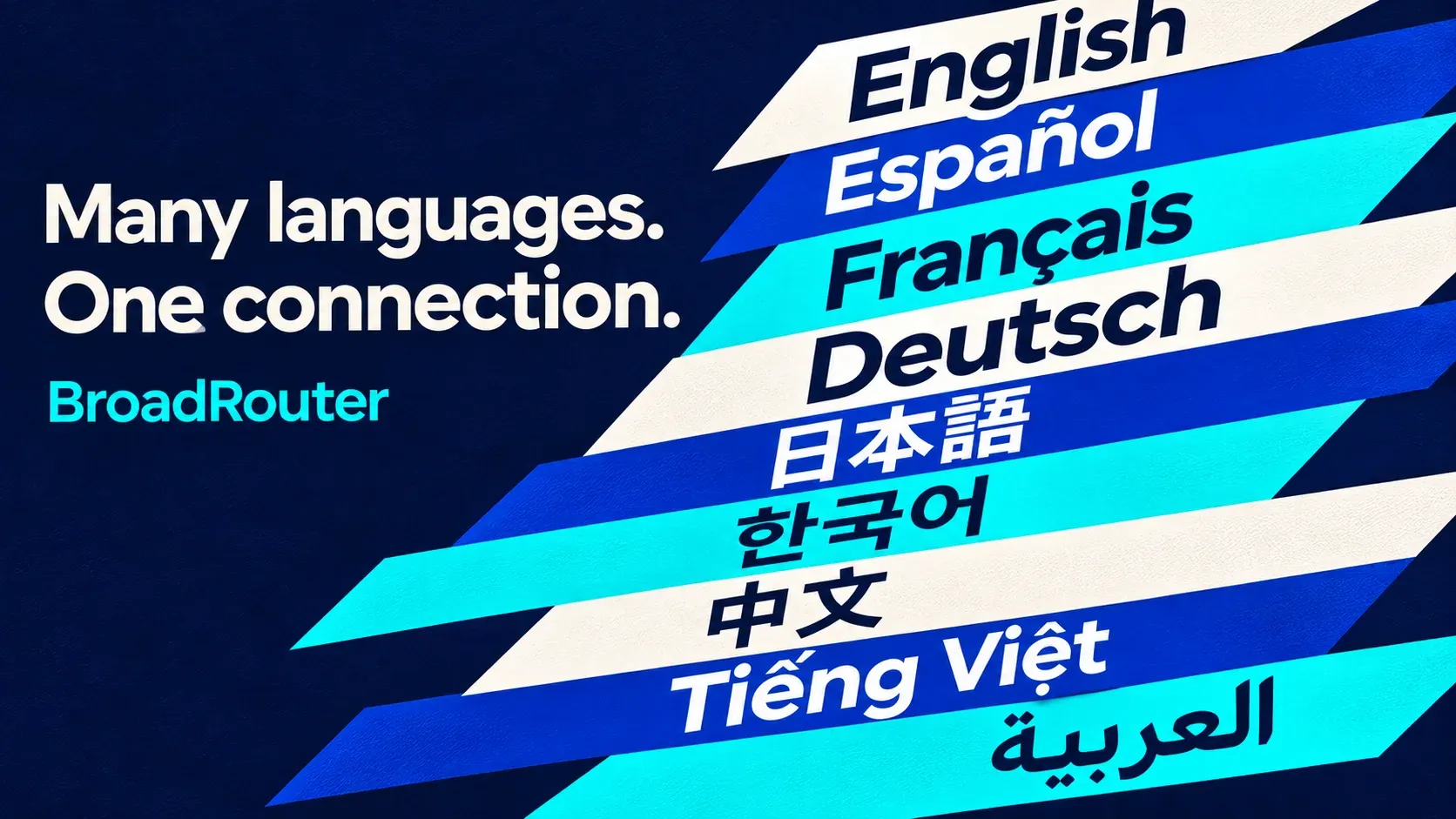
Most products that handle audio deal with more than one language: a global support line, meeting recordings from different offices, a voice-note inbox in a multilingual city. Running one speech-to-text vendor per language is a maintenance cost. BroadNet Transcribe puts 14 languages behind one OpenAI-compatible endpoint, priced per audio minute, with a specialised Arabic model next to it for Arabic-heavy workloads.
Which languages does BroadNet Transcribe cover?
The language list comes from BroadNet’s published pricing.json, as ISO 639-1 codes:
| Code | Language | Code | Language |
|---|---|---|---|
| en | English | nl | Dutch |
| es | Spanish | pl | Polish |
| fr | French | zh | Chinese |
| de | German | ja | Japanese |
| it | Italian | ko | Korean |
| pt | Portuguese | vi | Vietnamese |
| el | Greek | ar | Arabic |
BroadNet Transcribe is based on Cohere Transcribe and is served by BroadNet. The model id is broadnet/cohere-transcribe.
For the full picture, our open speech-to-text API price index lists batch and streaming prices, billing increments and Arabic support for more than 20 products, each checked against the provider’s own pricing page (CSV and JSON).
How much does multilingual transcription cost?
| Model | Per minute | Per hour | Languages |
|---|---|---|---|
| BroadNet Transcribe | $0.002 | $0.12 | 14 |
| BroadNet Transcribe Arabic | $0.0042 | $0.25 | Arabic |
Billing is per minute of audio, not per request or per token. Both models work on the free $5 starting credit, so you can test your own recordings before topping up. See all prices on the pricing page, price your monthly hours in the speech-to-text cost calculator, or compare other providers in speech-to-text API pricing compared.
How do you call the transcription endpoint?
The endpoint follows the OpenAI audio transcription shape, so the official SDKs work with a changed base URL:
import os
from openai import OpenAI

client = OpenAI(base_url="https://inference.broadnet.ai/v1", api_key=os.environ["BROADNET_API_KEY"])

with open("meeting-fr.mp3", "rb") as audio:
    result = client.audio.transcriptions.create(
        model="broadnet/cohere-transcribe",
        file=audio,
        language="fr",
    )
print(result.text)
Or with curl:
curl https://inference.broadnet.ai/v1/audio/transcriptions \
  -H "Authorization: Bearer $BROADNET_API_KEY" \
  -F model=broadnet/cohere-transcribe \
  -F language=es \
  -F file=@llamada.wav
The response is JSON with the transcript in text. BroadNet’s documented response is the text itself; if you need word timestamps or speaker labels, check the API reference for what is currently supported before you design around them.
Why should you always send the language?
BroadNet’s docs are explicit: send language with every transcription request. Without it, Arabic can come back transliterated into Latin letters, and the same risk applies to any language the model might confuse. If you do not know the language in advance:
- Use metadata first. The caller’s country, the user’s app language or the phone number prefix is usually right.
- Ask the user in voice products (“press 1 for English, 2 for Arabic”).
- Try a short sample. Transcribe the first 30 seconds with your best guess; if the text looks wrong (wrong script, gibberish), retry with the next candidate.
What are the limits and formats?
- Formats: WAV (
audio/wav) or MP3 (audio/mpeg). Convert .ogg, .m4a, .webm and video files with ffmpeg first. The WhatsApp voice-note guide has the one-liner. - Size: up to 26,214,400 bytes (25 MiB) per file; larger files return 413. That is about 13 minutes of 16 kHz mono WAV or about 54 minutes of 64 kbit/s MP3. Split longer audio with
ffmpeg -f segment -segment_time 600. - Rate: a pay-as-you-go key allows 30 requests a minute and 4 at once. Retry 429 with backoff; see errors and retries.
- Privacy: audio and transcripts are processed for the request and not retained. See zero data retention.
For a production batch pipeline with chunking and a worker pool, see Arabic call-centre transcription at scale; the same design works for any of the 14 languages.
When should you choose the Arabic-specific model?
BroadNet offers two models because Arabic is harder than most languages for speech recognition: many dialects under one written standard, frequent code-switching with English and French, and a lot of phone-quality audio. BroadNet Transcribe Arabic is the specialised option, and BroadNet publishes Arabic accuracy only for it:
- BroadNet reports it at #2 of 37 (its September 2026 figure; the live board listed it #4 of 39 on 15 November 2026) on the Open Universal Arabic ASR Leaderboard, and #1 among models whose licences permit API serving.
- BroadNet’s lab word error rates: 3.8 on FLEURS-ar, 21.1 on MASC-ar and 23.4 on its dialect set (lower is better). What those numbers mean.
BroadNet does not publish Arabic numbers for the 14-language model, but the public leaderboard does: on 15 November 2026 it listed Cohere Transcribe 03-2026, the model behind BroadNet Transcribe, at #8 of 39 with an average WER of 30.67, against 24.19 for the Arabic model at #4 of 39. For other languages, BroadNet reports 5.5 word error rate on FLEURS English and 3.2 on FLEURS Spanish for BroadNet Transcribe, and about 113 times realtime on one stream (217 times batched) on English audio, per its model page. A simple rule:
| Your audio | Choose |
|---|---|
| Mostly Arabic, any dialect | BroadNet Transcribe Arabic |
| Arabic is a minority of files, accuracy is not critical | BroadNet Transcribe for everything, or test both |
| Mixed portfolio with a known language per file | Route Arabic files to the Arabic model, the rest to BroadNet Transcribe |
| Any of the other 13 languages | BroadNet Transcribe |
Routing by language is a one-line change, since both models share the endpoint and request shape:
def stt_model(lang: str) -> str:
    return "broadnet/cohere-transcribe-arabic" if lang == "ar" else "broadnet/cohere-transcribe"
The Arabic model costs about twice as much per minute. At volume, test both on a few hours of your real Arabic audio and compare word error rate per dialect; the Arabic speech-to-text buyer’s guide has a one-hour test plan. If numbers, dates and names in noisy Arabic audio are the problem, BroadNet also lists a fine-tuned Arabic model on request on the models page.
How do you test accuracy in each language?
A single vendor accuracy figure hides big differences between languages, accents and recording conditions. Before you commit a workload, run a small test per language:
- Collect 20 to 50 real clips per language, from the channel you will actually transcribe: phone calls, meeting recordings, voice notes or video. Include your hardest accents.
- Write reference transcripts for a subset by hand, with agreed spelling rules for numbers, names and English loanwords.
- Transcribe with the correct
languagecode and compute word error rate per language. For Chinese and Japanese, which are written without spaces between words, use character error rate instead. - Read the errors. Product names, amounts and addresses matter more than filler words.
- Repeat for Arabic with both models if Arabic is part of your mix, and compare per dialect.
The $5 starting credit covers a test like this for several languages on BroadNet Transcribe, because the per-minute price is low.
What workloads does it suit?
| Workload | Notes |
|---|---|
| Multilingual support lines | Route by the IVR language choice; send the matching language code |
| Meeting notes for distributed teams | Transcribe per recording, then summarise with an LLM |
| Voice-note inboxes | Convert .ogg to WAV first; see the WhatsApp guide |
| Media and podcast archives | Split long files under 25 MiB; batch overnight |
| Language-learning apps | Transcribe learner speech, then give feedback with an LLM |
In every case the cost scales with audio minutes only: $0.12 per hour of audio on BroadNet Transcribe, whatever the language.
What happens after transcription?
Transcripts are rarely the end product. Common next steps on the same API key:
- Summaries and action items for meetings with DeepSeek V4.1 Flash, whose 1,048,576-token context fits very long transcripts.
- Translation of transcripts into one working language; see Arabic–English translation with LLMs.
- QA scoring of support calls with structured JSON output.
How do you migrate from another transcription API?
If you already call an OpenAI-style transcription endpoint, including the Whisper API that OpenAI lists as shutting down on February 26, 2027 (what to test before you switch), migration is usually three changes: base URL, API key and model id, plus making sure you send language. Check response fields your code reads beyond text. The OpenAI-compatible migration checklist covers the rest.