

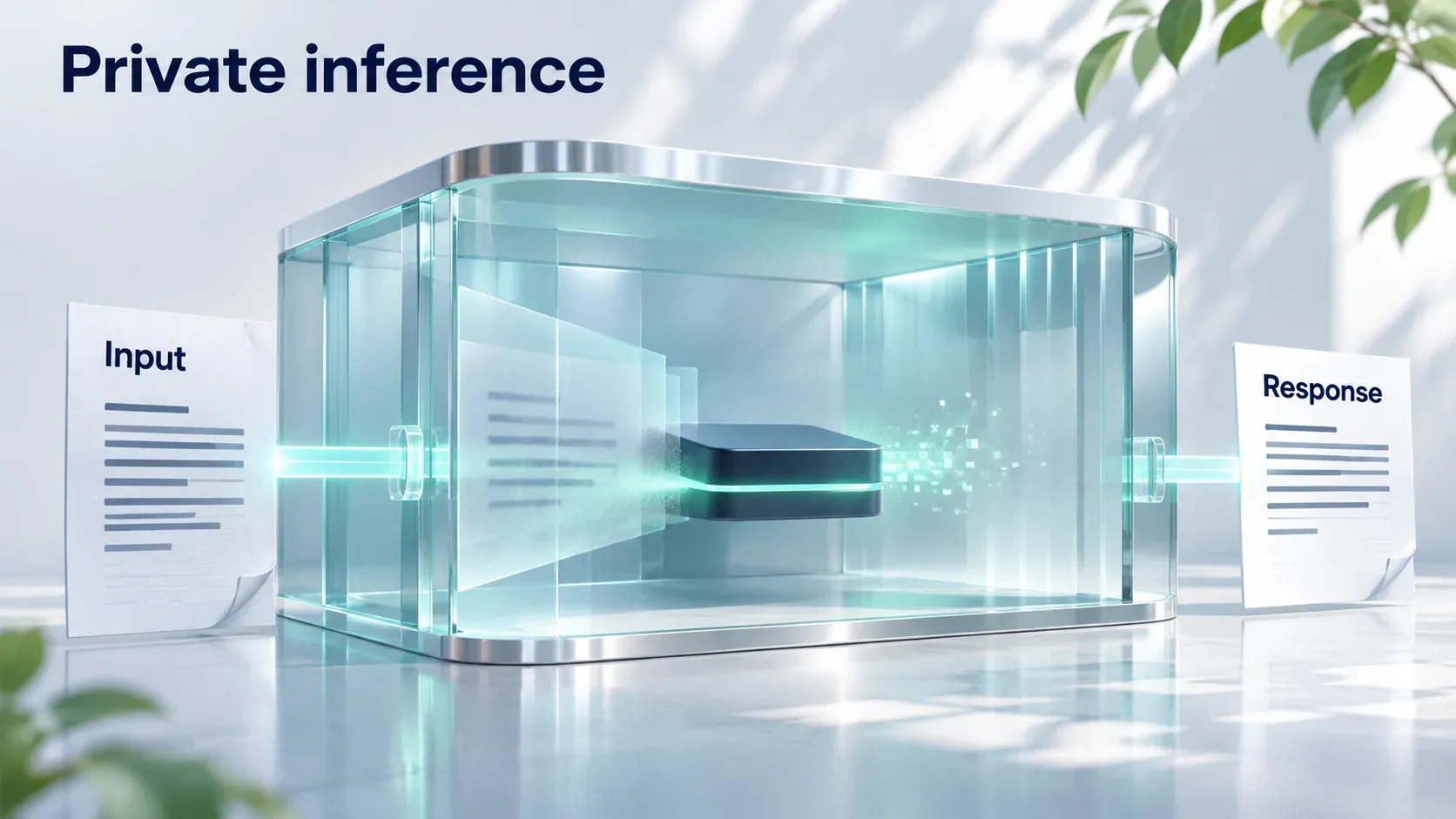
Coding agents send whole repositories. Support bots send customer messages. Transcription pipelines send phone calls. Before any of that goes to an LLM API, someone will ask: what happens to it after the answer comes back? “Zero data retention” (ZDR) is the answer people want to hear, but the phrase covers very different practices.
What should zero data retention cover?
Content that should not outlive the request:
- Prompts, system prompts and tool results
- Images and audio
- Model outputs and transcripts
- Full request and response bodies, including in debug logs
- Raw URLs, query strings and authentication values
Records that are normally kept, and should be content-free:
- Request IDs, timings, HTTP status, byte counts
- Account and key IDs, model, token counts, cost
- Client IP addresses, for security
If a provider can’t tell you which list each item is on, treat that as a “no”.
Are training, retention and ZDR the same promise?
| Promise | What it means | What it doesn’t mean |
|---|---|---|
| “Not used for training” | Your data won’t train future models | It may still be stored for a while |
| “Retained for N days” | Content is kept, then deleted | Staff or systems may access it meanwhile |
| “Zero data retention” | Content isn’t stored after the request | Metadata is still kept |
The large providers show why the difference matters. For a side-by-side of official wording from several providers, see LLM API data retention compared. OpenAI’s data controls page says that since March 1, 2023, API data is not used to train its models by default. The same page says abuse monitoring logs “are retained for up to 30 days”, that ZDR controls “are subject to prior approval by OpenAI”, and that endpoints which store state, such as files, assistants and batches, are not eligible. A provider can be honest on all three points and still keep your content for a month by default.
Where do ZDR promises usually have gaps?
- Eligibility. ZDR may need approval, a specific plan or a contract, and is off until it’s switched on.
- Endpoint scope. Chat may qualify while file storage, batches or fine-tuning don’t.
- Safety carve-outs. OpenRouter’s FAQ, for example, defines ZDR as “no routine storage of prompts or responses after processing, apart from a CSAM exception”.
- Layers above the model. A gateway, router or observability tool in between may log prompts even if the model provider doesn’t. Ask every layer.
- Your own systems. Your app logs, error trackers and analytics often keep more content than the provider does.
What 10 questions should you ask a provider?
- Are prompts and outputs stored after the request? Anywhere? Include logs, caches, queues and backups.
- Is any content used for training or evaluation? By you or by a model vendor?
- What do you keep, field by field? Ask for the list.
- How long are usage records kept, and why?
- Who runs the GPUs? Your provider, a cloud, or a reseller’s reseller?
- Which subprocessors can see request content?
- How is retention verified? A policy, or an automated check?
- Can keys be locked to my IP addresses? A leaked key is a data path too.
- Where is the hardware, and is regional placement available?
- What happens on a support ticket? Can staff see content when you report a bug?
Ask for the answers in writing, and note which document makes them binding: the terms, a privacy statement or a signed agreement.
How does BroadNet Inference answer them?
| Question | BroadNet Inference |
|---|---|
| Prompts, images, audio, answers stored | No; processed for the request and not retained |
| Training on your data | No; the privacy statement rules out training, fine-tuning and evaluation on inference data |
| What’s kept | Content-free traffic, usage and account records (full list) |
| How long records are kept | As long as billing, tax, security and legal obligations require |
| Verification | Gateway configuration checked hourly for content-free operation |
| Hardware | The privacy statement says hosted models run on “BroadNet-owned or leased hardware in the United States, with partner capacity as backup”; partner-served models run under ZDR terms with US inference partners |
| Data residency | Agree processing locations with BroadNet before sending data with residency requirements (GDPR checklist) |
| Key protection | IP allow-lists, up to 32 entries; changes and revocations apply to new requests within five seconds |
| Stored keys | SHA-256 hashes only; the raw key is shown once |
BroadNet’s docs describe zero data retention as “built into how we serve requests, not only stated in policy”. It applies to every request, with no setting to switch on. The details are in the privacy statement.
Does ZDR cover speech and Arabic audio?
Voice is the most sensitive input most products handle: a voice note can contain a name, a phone number and a health detail in ten seconds. If you transcribe calls or WhatsApp voice notes, ask the same ten questions about audio and transcripts. See the Arabic speech-to-text buyer’s guide.
How do you check a provider’s answers?
- Read the privacy statement and the API reference, not only the marketing page. Look for a field-by-field list.
- Check the scope. Which models, endpoints and plans does the promise cover?
- Look at what the API returns. If a dashboard shows your past prompts, they are stored somewhere.
- Ask about the support process. Who can see what when you open a ticket?
- Write the answers into your vendor record, with links and the date you checked.
What does ZDR not fix?
Zero data retention protects what happens after your request reaches the provider. You still need to:
- Keep API keys on servers, never in browsers or mobile apps
- Lock keys to your egress IPs with an IP allow-list
- Redact what the model doesn’t need, such as card numbers (how to redact before sending)
- Log request IDs on your side, so you can debug without the provider storing content; the errors guide shows what to send support
When you move an app from one provider to another, add these checks to the migration checklist. If you route through a gateway, ask it the same questions; the OpenRouter comparison shows how one router handles ZDR.
Where BroadNet Inference fits
BroadNet Inference suits teams that want ZDR on every request without applying for it, including on partner-hosted models, which its privacy statement says run under zero-data-retention terms with US inference partners. It keeps content-free records for billing and security, as every provider does. If you need your data processed in a specific region, agree processing locations with BroadNet before you send data; the default for its own and hosted models is the US.